

The William D. (Bill) Mensch, Jr. Best Use of Embedded Intelligence Innovation Award
Given at The UArizona College of Engineering on Design Day
Award Description: The Mensch Prize for Best Use of Embedded Intelligence recognizes the senior design team that best integrates embedded intelligence into a potential commercial or real-world product developed as part of the Interdisciplinary Engineering Capstone (ICAP) program.
Background: Embedded Intelligence, as described in The Theory of Embedded Intelligence (TEI), is characterized by a system’s ability to Sense, Process, Communicate, and Actuate (SPCA) in order to produce a beneficial outcome. The award emphasizes integrated system intelligence, thoughtful engineering design, and real-world operation. Projects may span embedded systems, intelligent systems, cyber-physical systems, Industry 4.0, Internet of Things (IoT), robotics, medical devices, transportation, energy, and related domains. These are all examples of Embedded Intelligence Technology.
Important Clarification on Embedded Intelligence
A project does not need to use machine learning, neural networks, or cloud-based AI to qualify for this award. Many of the strongest Embedded Intelligence projects are built around:
- Sensors and real-time decision-making
- Microcontrollers or microprocessors running deterministic or rule-based logic
- Control systems, safety systems, and edge intelligence
- Human-augmenting or autonomous systems operating under real-world constraints
If your system autonomously senses information, processes it, communicates as needed, and acts in the world (SPCA), it likely qualifies for the Mensch Prize.
Visit The Bill and Dianne Mensch Foundation, Inc. website at TheMenschFoundation.org to gain a better understanding of Computer Science and Engineering (CSE) concepts associated with The Theory of Embedded Intelligence (EI) and EIT.
CAUTION: As with the study of Consciousness, the study and application of Embedded Intelligence (EI) could change one’s life.
Self-Nomination Guide: Self-nomination is done through the Engineering Design Project Management (EDPM) system. Below is a helpful guide for nomination and example layout. All of this can be found in EDPM:
If your capstone project senses information, makes decisions, communicates, and acts in the real world, you are applying your own Embedded Intelligence and should nominate your project for this award.
What We’re Looking For:
– Integrated system intelligence
– Real-world embedded operation
– Clear benefit to people, safety, efficiency, or understanding
How to Nominate:
1. Describe your system and how SPCA works together
2. Explain how it augments or outperforms unaided human capability
3. Describe what is innovative
4. Include a simple system diagram
Use of AI Tools:
We encourage the use of the Mensch Theory of Embedded Intelligence GPT responsibly. From a TEI standpoint, using this custom GPT is not “outsourcing thinking.”
It is a textbook example of Augmented Human Intelligence (AHI)
—human intelligence extended by Embedded Intelligence Technology (EIT).This is precisely the philosophical ground the Mensch Prize stands on.
Students still:
- Design the system
- Build the prototype
- Make the decisions
- Own the ideas
The GPT simply helps:
- Recognize SPCA already present
- Articulate systems thinking
- Reflect on EI more clearly
Nomination document should be approximately 1-2 pages. Below is an example layout.
Example 1-Page Nomination Layout
The example below shows how a strong Mensch Prize self-nomination can fit on a single page.
Text, diagrams, and photos are all included within the 1–2 pages.
This is a guide, not a rigid template.Project Title
Team #XXXX – Short, Descriptive Project Name
Team Members & Majors
– Student Name (Major)
– Student Name (Major)
– Student Name (Major)
– Student Name (Major)1) SPCA System Narrative (Primary Content)
Briefly describe the real-world problem your project addresses and how your system operates as an integrated embedded intelligence system.
Explain how your project:
• Senses its environment or internal state
• Processes information to make decisions
• Communicates information internally or externally
• Actuates or takes action in the physical or digital world
This section is typically ½ to 1 page and serves as the core of the nomination.2) Human Capability Augmentation
Describe how your system augments, extends, or outperforms unaided human capability in its intended context.
Examples include improvements in speed, precision, safety, endurance, reliability, or consistency.3) Innovation
Describe what is innovative about your project.
Innovation may involve a novel technical approach, system integration, application of embedded intelligence, or improvement over existing solutions.4) Potential Impact
Briefly describe the potential impact of your project if further developed.
Impact may be technical, societal, environmental, educational, or commercial.5) System Diagram or Photos (Strongly Encouraged)
Include one clear system or block diagram showing how SPCA elements interact,
and/or one or two photos of your prototype in operation.
Diagrams and photos can be embedded in the document or attached separately.Tip: Many past Mensch Prize winners used a simple system diagram or annotated photo to clearly show where intelligence is embedded in their design.
Prize: Prize amount is $1,000. The amount may be reevaluated based on the available Payout from the endowment.
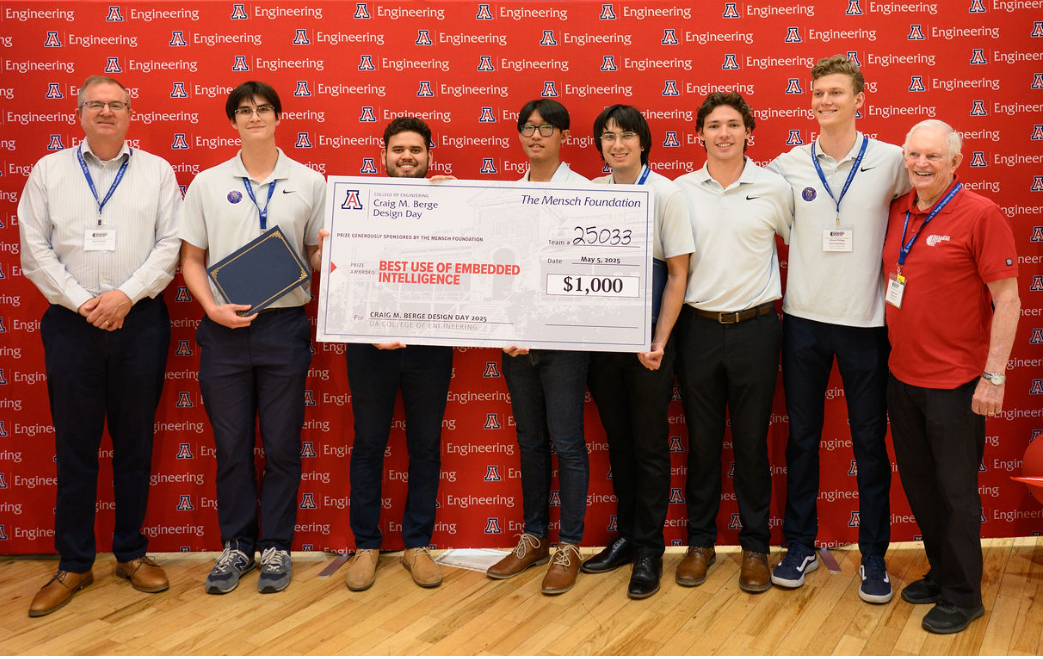
2025 Award Winner
Team #25033 MD-Sensei – The MD-Sensei (MD-S) platform is an advanced AI-driven solution acting as a Digital Clinical Mentor to deliver concise, situationally relevant,
real-life clinical guidance to Healthcare Workers (HCWs) in the developing world, at point-of-care, in real-time, and on-demand.
AI in Healthcare Article 2025 Engineering Design Day Article
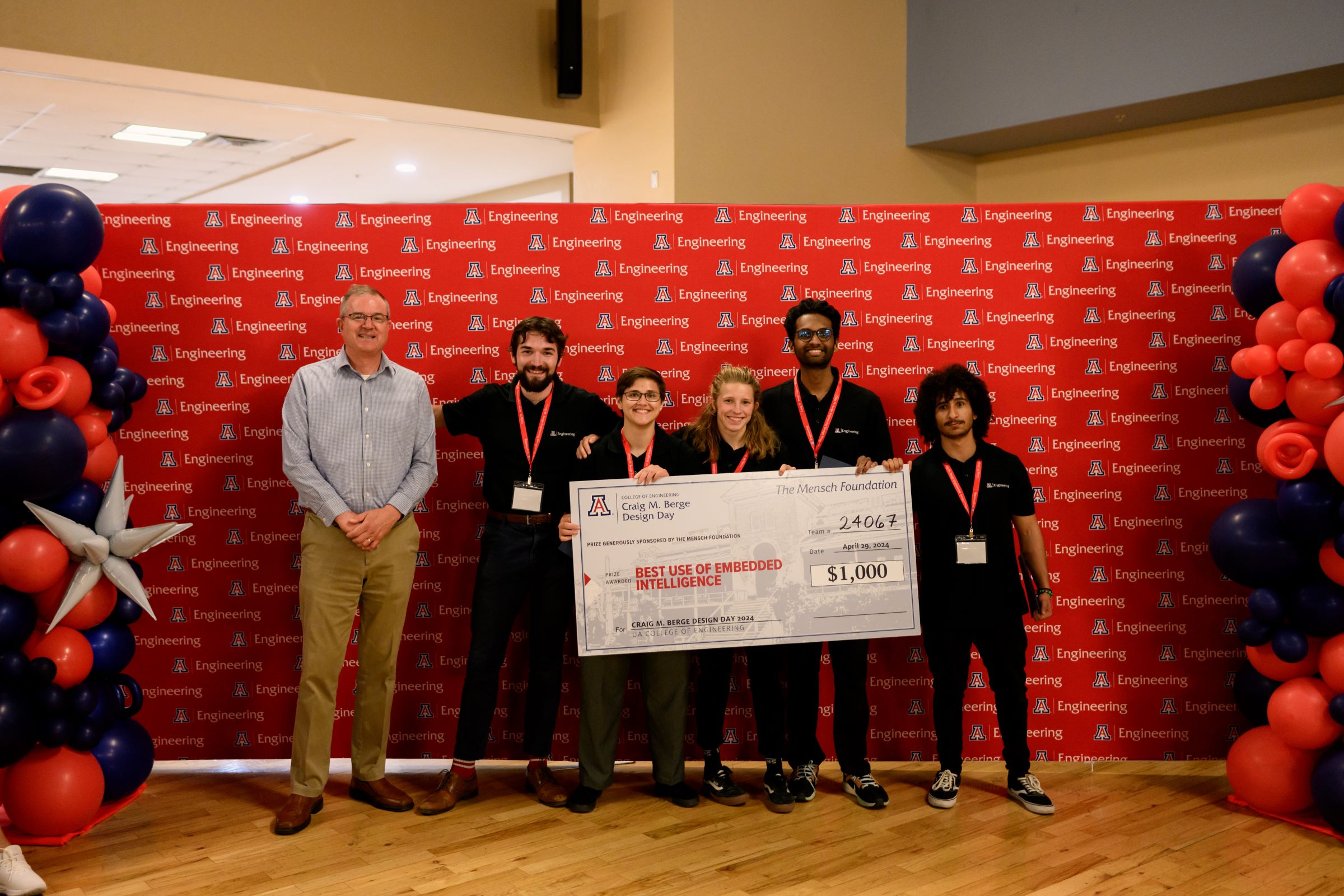
2024 Award Winner
Team #24067 Small Item Photographing Triage Robot (SIPhTR)
Read more about this project on their Capstone Project Page.
2023 Award Winner
Team #23088 Supplement Recommending Mobile App w/ Handheld Measuring Device for Saliva pH and Calcium Levels.
Read more about this project on the Capstone Project page.

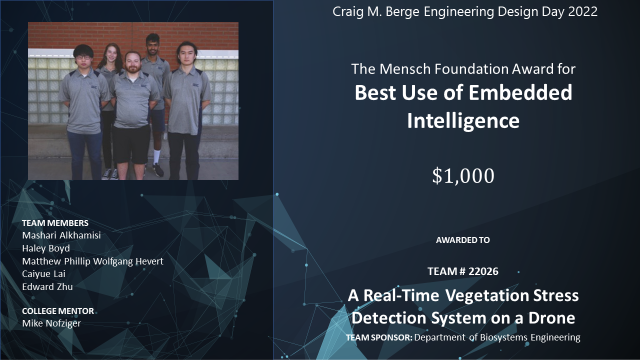
2022 Award Winner
Team #22026 A Realtime Vegetation Stress Detection System on a Drone
Read more about this project on the Capstone Project page.
2021 Award Winner
Team #21014 Advanced Hospital Bed System
Project Description: This project resolves the formation of pressure ulcers (bed sores) which are expensive to treat. Bedsores are a recurring problem for immobile patients and often lead to infection, necrosis, and other complications which are resource and cost-intensive to address.
Click here for Team #21014 Biography
2020 Award Winner
Team #19094 Biosphere 2 Controlled Systems Monitors
Project Description: To design and build real-time, low-cost, high precision, and high accuracy environmental monitoring systems for two controlled environments at The University of Arizona Biosphere 2 which demonstrate both aquatic and terrestrial applications of embedded sensor systems.
Click here for Team #19094 Biography
2019 Award Winner
Team #18055 Unmanned Aircraft Ground Control System for Automated Date Pollinator
Project Description: The system, designed in collaboration, controls an unmanned aircraft as it flies through a date palm plantation and pollinates the palms. The computational system mounted on the aircraft uses computer vision and artificial intelligence to observe, model and act on its environment to efficiently and safely complete the pollination process. This includes the identification of the palm trees, the command to release pollen, and the detection and avoidance of obstacles. The system provides the date farmers with a modular product capable of pollinating a field of date palm trees in an industrial-scale farming environment. This allows for significant savings by reducing labor costs and the risk of injury during manual pollination.